Operating heavy transport along the Dar es Salaam port corridor—whether heading west to Kigoma, north to Mwanza and Arusha, or crossing the border into Zambia and DRC—demands equipment that forgives neither downtime nor poor road conditions. Over the past decade advising logistics fleets across East Africa, I've watched too many operators bleed profit on under-specced flatbed semi trailers. This guide cuts through the sales chatter and focuses on what actually works for Tanzanian container haulage, from TRA compliance to the brutal reality of unpaved sections on the Tunduma-Mbeya route.
Who & Where: Serving the Dar es Salaam–East African Corridor
Your flatbed semi trailer is the backbone of intermodal freight moving through Dar es Salaam port, the busiest gateway for Tanzania, Burundi, Rwanda, Uganda, and eastern DRC. The typical mission profile:
- Port extraction: Stacked 20ft or 40ft laden containers from port terminal to inland container depots (ICDs) like Ubungo or Kisarawe.
- Long-haul corridors: Up to 1,400 km runs to Mwanza (Lake Zone), Arusha (northern circuit), or cross-border to Lubumbashi (DRC) and Ndola (Zambia).
- Mixed cargo + containers: Many fleet owners combine container freight with loose construction steel, agricultural machinery, or bagged cement on the return leg—requiring a versatile tri-axle platform trailer with twist locks and flatbed flexibility.
The Tanzania Revenue Authority (TRA) enforces strict axle load limits at weighbridges in Chalinze, Manyoni, and Tunduma. A well-spec'd 3 axle flatbed trailer keeps you legal while maximizing payload. More importantly, it survives the heat (up to 35°C+ and high humidity near the coast) and the vibration washboard sections of the central corridor. My field inspections confirm that poorly braced suspension mounts crack within 18 months on these roads; premium engineering doubles that lifespan.
|
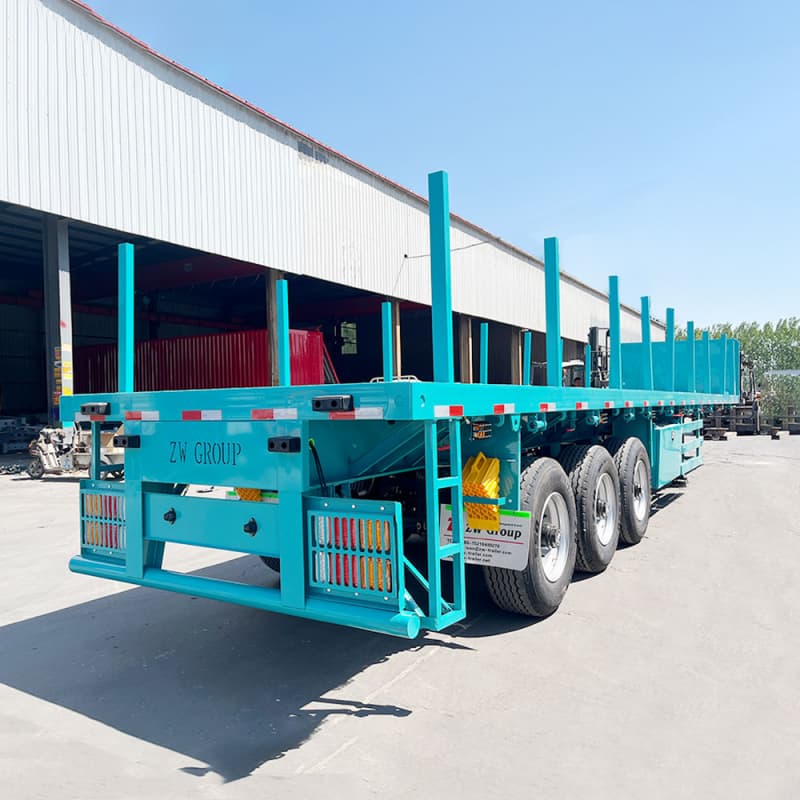
Flatbed Semi Trailer 40ft 3 Axles 80t Cyan With Side Bar Stick Pipe
This custom flat deck trailer is highly recommended for transporting timber, steel pipes, and heavy equipment. Equipped with robust side bar stick pipes, it ensures maximum stability and security for specialized heavy hauling.
|
|
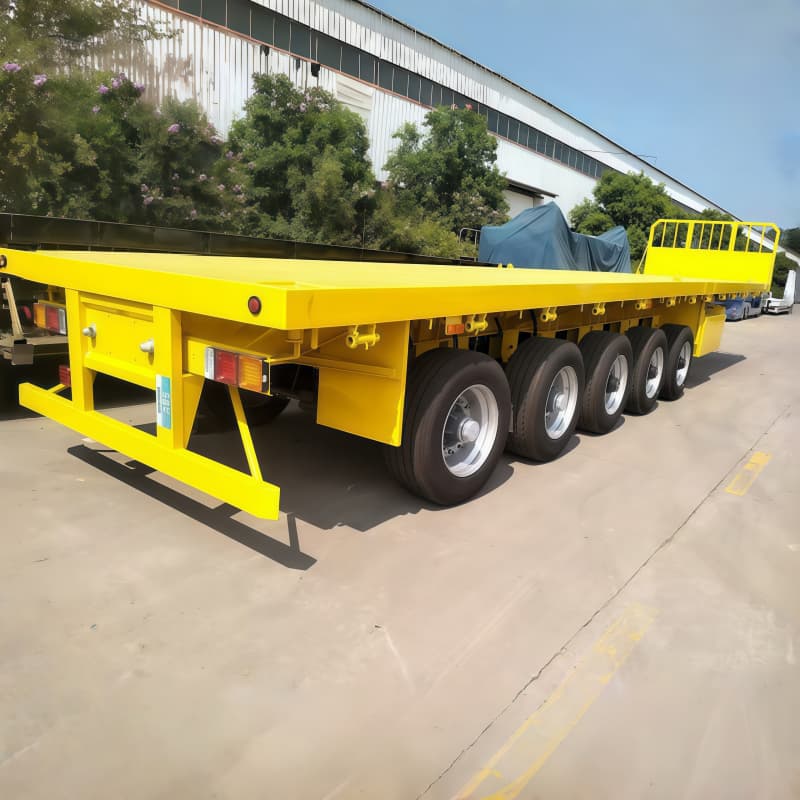
Flatbed Semi Trailer 12.5m 5 Axles 100t Yellow
A heavy-duty flat deck trailer designed to handle extreme payloads. Built with 5 axles for optimal weight distribution, this yellow semi-trailer is perfect for massive industrial loads and challenging terrain conditions.
|
|
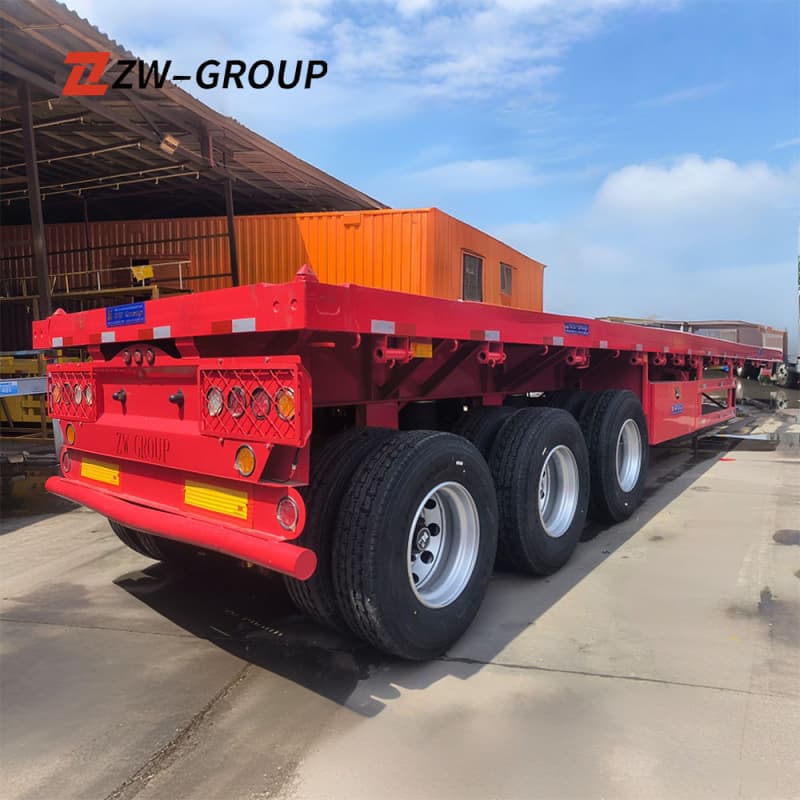
Flatbed Semi Trailer 12.5m 3 Axles 60t Red
Featuring an ideal flat deck trailer axle configuration, this 3-axle red flatbed trailer offers the perfect balance of agility, strength, and structural integrity for mid-to-heavy freight transport.
|
|
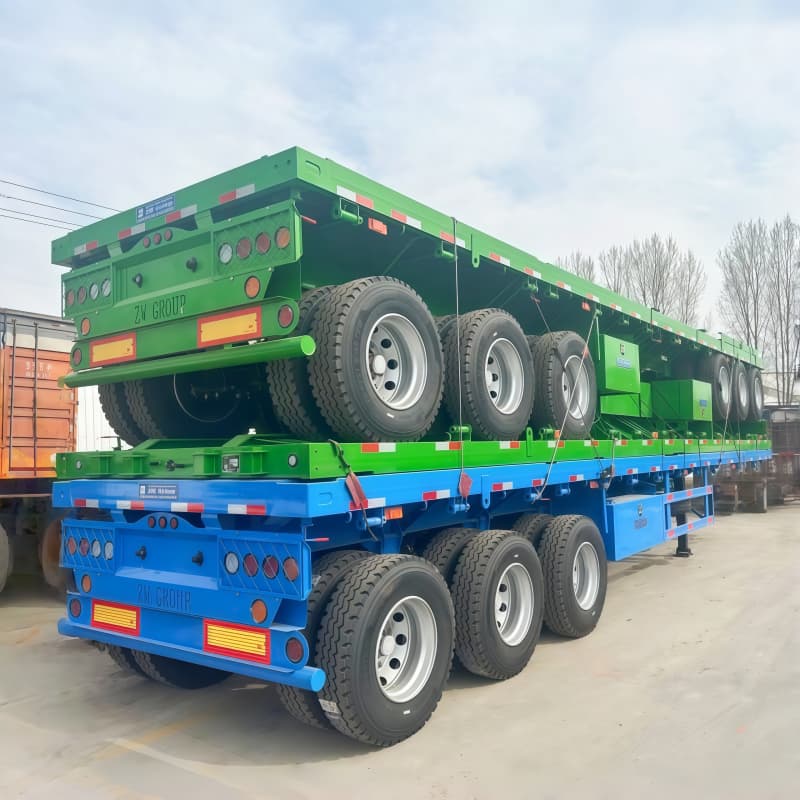
Container Flatbed Semi Trailer 40ft 3 Axles 60t Green
Engineered by leading flat deck trailer manufacturers, this 40ft 3-axle green semi-trailer is optimized for seamless container logistics, combining lightweight structural engineering with high load-bearing capacity.
|
What & Why: High-Strength Steel, Chassis Engineering & Component Selection
Why do some flatbed trailers still run strong after 8 years of Tanzanian abuse while others twist like pretzels after two? It starts with the steel grade and fabrication method. A genuine 40ft container trailer for this market must use Q345B high-strength steel (minimum yield strength 345 MPa) for the main beams and crossmembers. Here’s what that delivers:
- Higher fatigue resistance: Withstands repeated torsional stress from uneven roads, preventing cracks around the kingpin and suspension brackets.
- Thickened floor plate (6mm minimum): Many Asian-built budget trailers use 3-4mm floors that oil-can and tear under point loads like fork tines or steel coils. For heavy minerals or machinery, demand 8mm floor plates.
- Robust twist lock system: A set of 12 container twist locks (spaced according to ISO 20ft and 40ft positions) allows rapid reconfiguration. In practice, your crew can swap between two 20ft containers or a single 40ft unit in under ten minutes without tools. Look for self-retracting locking handles and reinforced mounting plates.
Component selection separates uptime from downtime:
- Landing gear: JOST or SAF-HOLLAND legs are non-negotiable. Their gear ratios (40:1 or 48:1) handle the high static loads of a fully laden trailer (40-60 tons) on uneven ground. Cheap landing gear fails when you drop a loaded container at a dusty ICD, costing you crane rental and hours of delays.
- Axle & suspension choice: FUWA 16-ton axles offer excellent value and parts availability across East Africa (Nairobi, Dar, Mwanza). BPW ECO Plus axles with mechanical suspension provide lower rolling resistance and longer brake life, ideal for fleets running 200,000+ km/year. Both allow easy change of brake shoes and wheel bearings. Mechanical suspension (leaf spring) is the only reliable choice for rough roads; airbags puncture too easily on laterite gravel.
When & How: Maintenance Cycles & Container Switching Workflow
Based on load cycles typical for heavy-duty transport in Tanzania (average 3–5 trips per week, mostly Tarehe-Sita to Tunduma or Mbeya), follow this maintenance rhythm:
- Every 5,000 km (or 2 weeks): Grease all 14 suspension pivot points (seven per side) with lithium-based grease; check twist lock bolts for tightness; inspect brake slack adjusters. Dar’s salty air accelerates corrosion, so apply anti-seize on u-bolts.
- Every 15,000 km (monthly): Torque wheel nuts to 550-600 Nm; inspect spring leaves for cracks; measure kingpin wear (replace if throat exceeds 1.5mm ovality); test landing gear operation under load.
- Every 60,000 km (or 6 months): Replace brake linings if worn to 8mm; repack wheel bearings with high-temperature grease; inspect fifth wheel plate for uneven wear.
Switching between 20ft and 40ft containers: The 40ft container trailer with 12 twist locks uses a standardized process: (1) Lower landing gear and disconnect air/electric lines; (2) Retract the four corner twist locks for the current container; (3) Drive tractor forward; (4) Position next container type, aligning its corner castings with the appropriate twist locks (20ft positions are inboard at 5,900mm from kingpin, 40ft at 12,000mm); (5) Engage all 12 locks manually—always do a visual check. Crews familiar with this workflow can complete a swap in 8-12 minutes, maximizing daily trips.
Technical Specification at a Glance: Why These Numbers Matter for Tanzanian Roads
The following parameters represent the optimal configuration for a tri-axle flatbed trailer used in East African corridor container logistics. Sticking to these ensures TRA compliance and optimal payload.
| Parameter | Recommended Value | Benefit for Tanzania Ops |
|---|---|---|
| Overall Dimensions (L×W×H) | 12500 x 2500 x 1550 mm | Fits standard 40ft ISO container + legal width for East African roads; height allows low center of gravity for stability on rough curves. |
| Payload Capacity | 40 – 60 Tons | Matches legal axle load limits: 3 axles × 16 tons = 48 tons max (including tractor). 60-ton design margin for low-density bulky cargo or mining spares. |
| Axles (Model & Rating) | 3 Axles, 13 or 16 tons each (FUWA/BPW) | 13T for general cargo; 16T for heavy aggregates/minerals. Extra-heavy duty spring stack and 120x120mm axle beam required. |
| Tires | 12R22.5 (18-ply radial) | High load capacity and heat resistance. 12 units (including two spares) give excellent footprint for loose gravel shoulders. |
| Main Beam Steel | Q345B (8mm web, 14mm flange) | Superior yield strength; resists cracking when traversing washboard roads at moderate speed (40–60 km/h). |
| Suspension Type | Mechanical leaf spring (10+7 leaves) | Proven durability in high heat/dust; easily repairable in towns like Morogoro or Sumbawanga. |
Frequently Asked Questions – From TRA Compliance to ROI
Final field advice: Before signing any purchase contract, request a test run with a loaded 20ft container (25 tons) over a known rough road, e.g., the Dar–Bagamoyo gravel loop. Listen for suspension squeaks and check for chassis twist by measuring deck diagonals (tolerance within 5mm). Only commit to suppliers who provide a verified parts network in Dar or Mwanza for FUWA axles and JOST landing gear. Your per-trip profitability depends on avoiding the long-term corrosion and fatigue that kills poorly built flatbed semi trailers within 18 months.