A major infrastructure and logistics contractor operating across Burkina Faso's mining concessions recently executed a high-stakes procurement: the deployment of a fleet of Removable Gooseneck (RGN) semi-trailers designed to handle out-of-gauge cargo from the port of Tema (Ghana) and Abidjan (Côte d'Ivoire) to remote sites near Ouagadougou and the Sahel region. The primary challenge was moving 70-ton crawler excavators, 50-ton bulldozers, and mining shovels across cross-border corridors where fixed-neck lowboys consistently failed due to overhead bridge strikes and seasonal road degradation.
Field data from this deployment revealed that investing in heavy-duty hydraulic RGN lowboys reduced loading cycle times by over 40% compared to crane-dependent systems while eliminating clearance conflicts on the critical N1 corridor. The following technical analysis draws from direct engineering observations and post-deployment performance audits of the detachable gooseneck lowboy configuration selected for this challenging West African operating environment.

The Technical Anatomy of a High-Temperature, Dust-Optimized RGN Configuration
For Burkina Faso's demanding operating conditions—ambient temperatures exceeding 45°C, abrasive lateritic dust, and unpaved laterite roads—the contractor specified a double drop deck trailer built with high-tensile steel (100k flange / 80k web). This material selection resists fatigue cracking common in standard-grade frames when subjected to intense torsional stresses from uneven terrain. The deep drop deck structure achieves a loaded deck height of just 18 inches (range: 12–24 inches), which is critical for maintaining vertical clearance under the region's aging rail overpasses and colonial-era bridges.
Variable ride height control mechanisms allow the operator to raise the deck by up to 8 inches when navigating flooded crossings or deep ruts, then lower it back to the minimum legal height for permit compliance. All hydraulic circuits are sealed with high-temperature Viton seals, and the auxiliary power unit (APU/pony motor) is equipped with a cyclonic pre-filter to prevent dust ingestion—a direct lesson learned from premature pump failures observed on standard-spec RGN units in similar Sahelian deployments.
Field-Validated Specification for Sahelian Corridors: The contractor's five RGN units utilize a tri-axle and 4-axle flip axle extension configuration to comply with axle weight distribution laws while achieving a maximum payload capacity of 85 tons on the main deck, and up to 110 tons with the flip axle engaged. Each trailer is fitted with premium Apitong wood decking, which outlasts steel or oak alternatives by 3:1 under tracked vehicle loads due to its self-healing grain and high impact resistance.
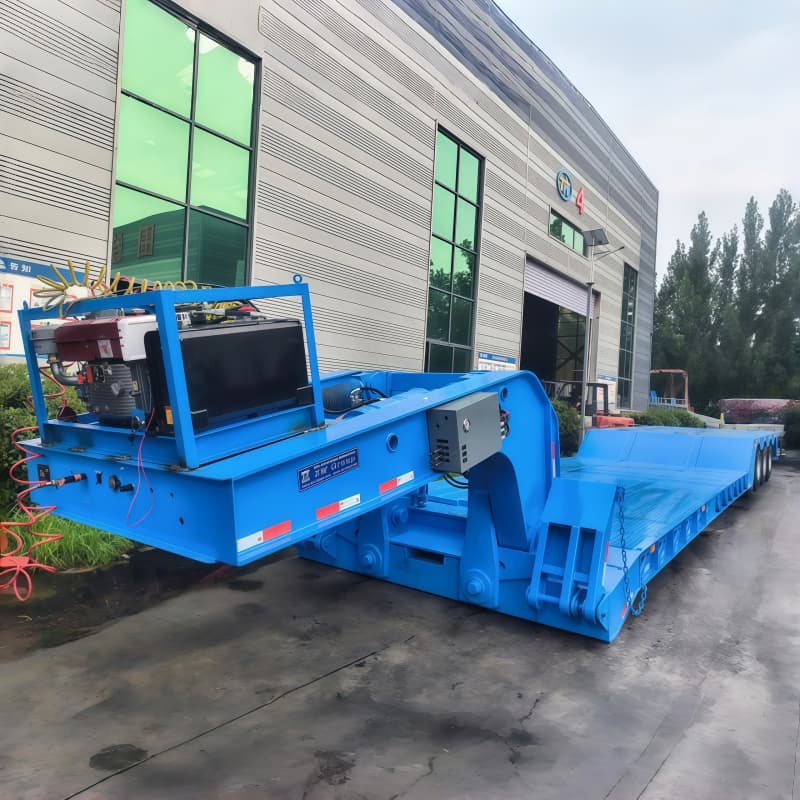 |
Removable Gooseneck Semi Trailer 85t 4 Axles BlueWe highly recommend this heavy-duty removable gooseneck semi trailer featuring an 85-ton capacity and 4 durable axles. Perfect for transporting large machinery and oversized cargo safely. |
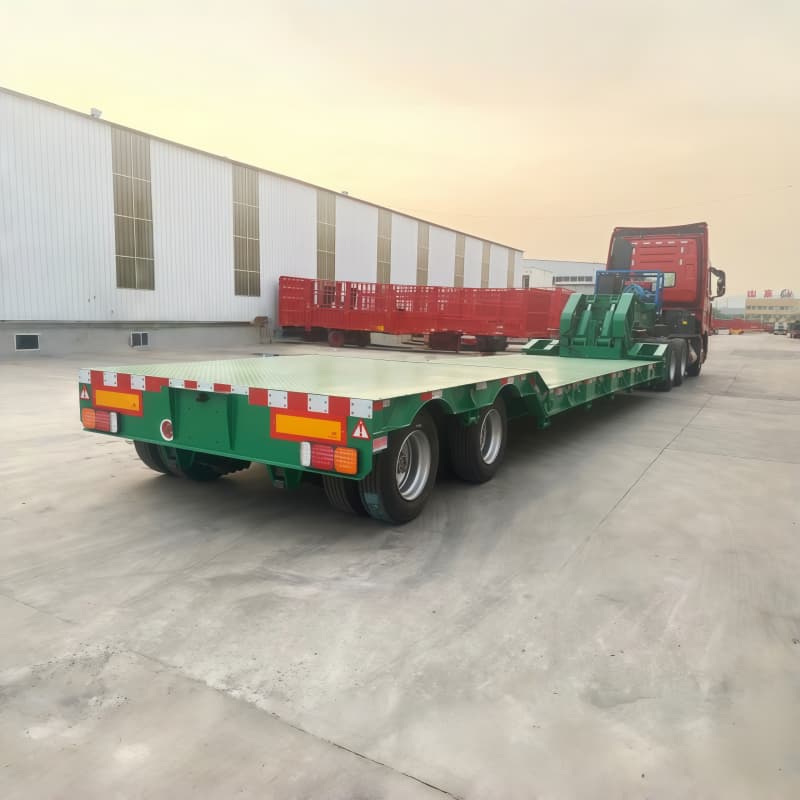 |
Removable Gooseneck Semi Trailer 50t 2 Axles GreenAn efficient transport solution with a 50-ton loading capacity and 2 axles. This green gooseneck trailer offers excellent stability and effortless front-loading operations. |
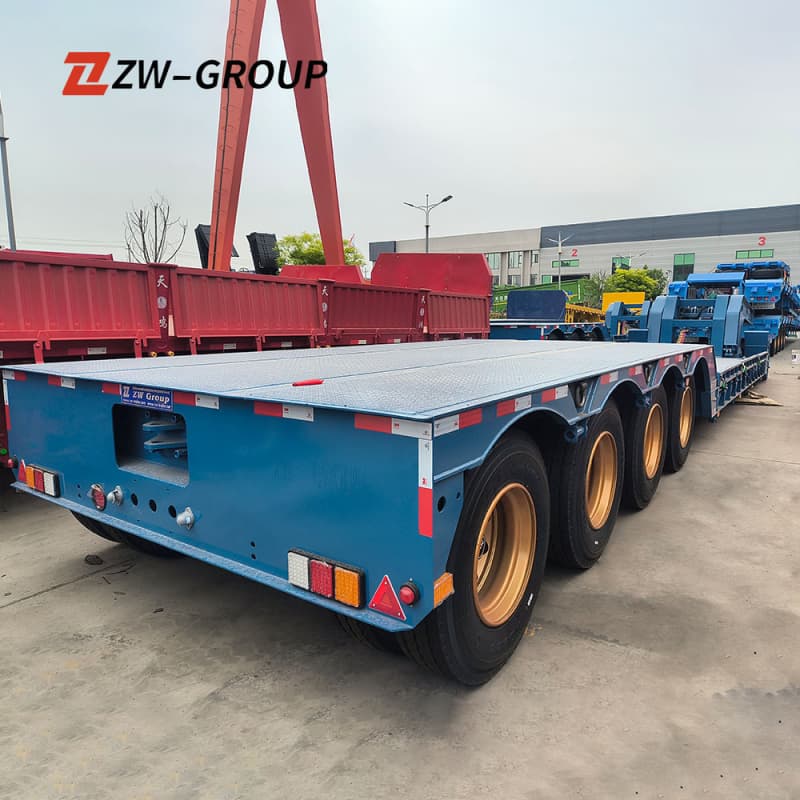 |
Removable Gooseneck Semi Trailer 75t 4 Axles 15m BlueThis 15-meter lowboy trailer is designed for medium to heavy equipment transport, boasting a 75-ton capacity and 3 robust axles with premium structural steel. |
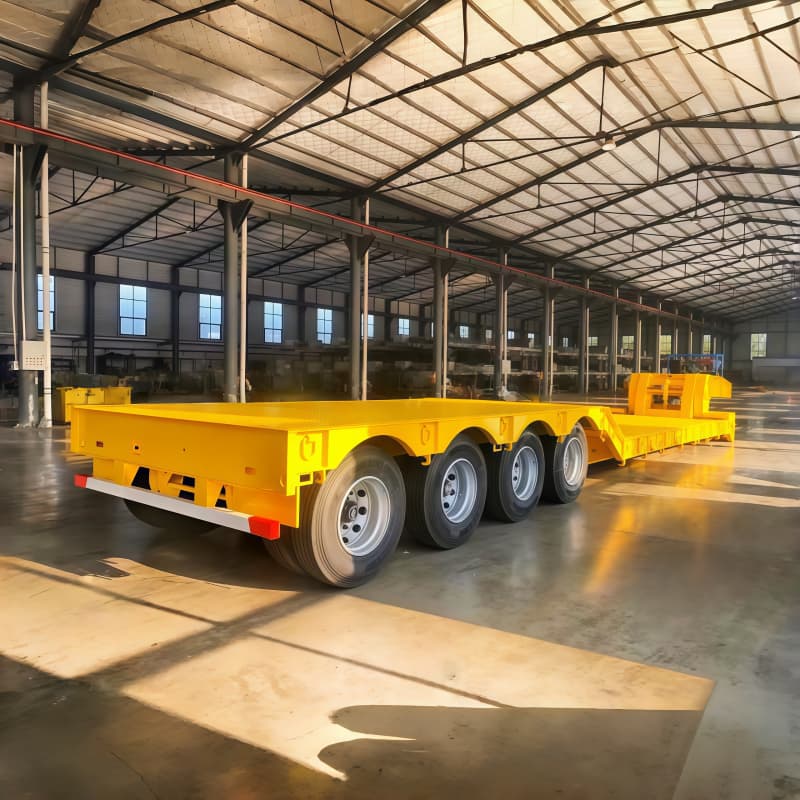 |
Removable Gooseneck Semi Trailer 90t 4 Axles YellowTop choice for extreme haulage requirements. Featuring a massive 90-ton capacity, 4 heavy axles, and a highly visible yellow coating for enhanced industrial safety. |
Competitive Technical Benchmarks for Heavy-Haul Trailers
Analysis of leading heavy-haul manufacturers (including XL Specialized, Trail King, and Felling) informed the specification of swing-out and aluminum pull-out outriggers for handling over-width pavers and agricultural machinery. These outriggers provide 24 inches of additional lateral stability without adding permanent width, allowing the trailer to remain permit-compliant for routine corridor travel while expanding capacity for site-specific oversize moves.
Comparative Technical Data: Payload, Axle Configurations & Deck Parameters
The table below summarizes the three RGN variants deployed for the Burkina Faso contractor, covering the heavy equipment transport range from 35-ton light civil machinery to 100+ ton mining shovels.
| Model / Configuration | Payload Capacity (tons) | Axle Configuration | Minimum Deck Height (in) | Main Deck Length (ft) | GVWR (lbs) |
|---|---|---|---|---|---|
| RGN 35T (Tandem) | 35 | Tandem (2 axles) | 14 | 22 | 88,000 |
| RGN 50T (Tri-axle) | 50 | Tri-axle | 16 | 24 | 120,000 |
| RGN 85T (4-axle + flip axle) | 85 (expandable to 110) | 4-axle + flip axle extension | 18 | 28 | 180,000+ |
Why the Hydraulic RGN Lowboy Outperforms Fixed-Neck Lowboys in West African Cross-Border Hauls
Traditional fixed-neck lowboys require crane-assisted loading or extended ramps, both of which are impractical at remote mine sites. The detachable gooseneck lowboy solves this through a front-loading ramp mechanism: once the gooseneck is hydraulically detached and the main deck grounds, the trailer becomes a grade-accessible ramp. This eliminates the need for mobile cranes and reduces the loading crew to a single operator.
More critically, the deep drop deck and variable ride height allow the trailer to adapt to the region's structural limits. On the corridor from Abidjan to Bobo-Dioulasso, a fixed-neck lowboy would have a top-of-deck height of 48–54 inches, often exceeding bridge clearance signs posted at 4.5 meters (177 inches) when carrying a 12-foot tall excavator. The double drop deck trailer with a loaded deck height of 18 inches keeps the total vehicle height under 162 inches, providing a 15-inch safety margin.
- Mechanical fatigue reduction: The RGN's articulated joint absorbs longitudinal shocks during convoy braking, reducing stress on the tractor's fifth wheel and frame.
- Cross-border permit flexibility: Multi-axle configurations (tandem, tri-axle, 4-axle, flip axle) allow on-the-fly adjustment of axle weight distribution to meet varying national limits (e.g., 13 tons/axle in Ghana vs. 11.5 tons/axle in Burkina Faso).
- One-man loading operation: The hydraulic APU operates independently of the tractor, allowing the operator to detach, load, and recouple without assistance—critical in remote areas where labor is scarce.
Step-by-Step Field Breakdown: Detaching, Loading, and Recoupling the RGN Trailer
During the Burkina Faso deployment, the contractor's team followed a standardized 12-minute procedure for loading a 65-ton crawler excavator without support equipment. The sequence is predicated on stable, relatively level ground (maximum 3-degree longitudinal slope).
- Hydraulic system activation: The pony motor (APU) pressurizes the hydraulic cylinders to 2,500 psi. The operator releases the gooseneck lock pins and extends the front support legs.
- Gooseneck detachment: The tractor pulls forward slowly. The gooseneck pivots down, and the main deck front edge contacts the ground. The deck is now at a 7–10 degree ramp angle.
- Equipment loading: The crawler excavator self-propels onto the Apitong wood decking. For tracked heavy machinery, the operator engages the swing-out outriggers to prevent lateral deck tilt during the climbing maneuver.
- Recoupling: The tractor backs under the gooseneck until the kingpin engages. Hydraulic pressure is reapplied to lift the deck to travel height, and lock pins are re-inserted. The entire process is performed without the tractor leaving the cab (except for pin checks).
Adapting RGN Operations to Burkina Faso's High-Temperature, Unpaved Corridors
Field engineering after the first 2,000 km of operation identified three critical adaptations. First, the standard hydraulic oil (ISO VG 46) was replaced with a synthetic VG 68 grade to maintain viscosity above 100°C. Second, the APU's air intake was relocated to the tractor's filtered air stream using a simple duct adapter, cutting dust-related hydraulic valve failures by 90%. Third, the kingpin setting was adjusted to a 14-inch height (from the standard 12 inches) to match the 6x4 heavy tractors (such as Volvo FMX and Mercedes Actros) commonly used in the region, ensuring proper fifth wheel load distribution.
The contractor also implemented a mandatory axle weight re-balancing procedure before crossing any bridge with a posted structural limit. By using the flip axle extension (converting a 4-axle unit to a 5-axle configuration), the per-axle load dropped from 17.5 tons to 14 tons, meeting national permit requirements without offloading cargo—a process that previously cost 8–10 hours per border crossing with traditional fixed-neck trailers.
Stabilization and Ground Clearance on Laterite Roads
Lateral stability on unpaved laterite roads—characterized by washboarding and soft shoulders—is maintained through a combination of heavy-duty aluminum pull-out outriggers and load-dependent tire pressure adjustments. The RGN's low center of gravity (due to the deep drop deck) reduces roll moment by 40% compared to a traditional lowboy, a decisive safety factor when negotiating crowned roads with 80-ton payloads. All outriggers were field-modified with replaceable HDPE skid shoes to prevent gouging into the soft laterite surface, a modification now incorporated into the contractor's standard procurement specification.
---
Frequently Asked Questions (FAQ) for Heavy Transport Managers
What ground conditions are required to safely detach an RGN gooseneck?
The primary deck must be supported on ground compacted to at least 300 kPa (typical of dry laterite or gravel). The longitudinal slope must not exceed 3 degrees, and the lateral slope must be under 1.5 degrees. In Burkina's rainy season, operators should place 3/4-inch steel plates under the support legs to prevent sinking into softened clay.
How often should hydraulic couplings be serviced in dusty, high-heat environments?
Based on Sahel deployment data, full hydraulic oil and filter change intervals should be reduced from 2,000 hours to 1,000 hours. Quick-coupler seals (Viton type) require visual inspection every 250 operating hours; dust intrusion is the leading cause of cylinder scoring. Cleaning the APU air filter weekly using compressed air is highly recommended.
What is the maximum payload capacity when using flip axle extensions on an RGN?
A 4-axle RGN semi-trailer rated for 85 tons can achieve a 110-ton capacity with the flip axle deployed, provided the tractor has a GVWR exceeding 80,000 lbs and route permits allow for the expanded axle spacing. The ultimate limiting factor is the kingpin drawbar capacity; heavy-duty 80k lb kingpins allow up to 120 tons with appropriate safety margins.
Why choose Apitong wood decking over steel or oak for tracked machinery?
Apitong's hardness (3,700 lbf on the Janka scale) and natural oil content resist splitting from steel track grousers. Steel decking develops sharp burrs that damage rubber tracks, while oak splinters and rots quickly in humid coastal ports like Tema. A 2.5-inch Apitong deck outlasts oak by 4:1 under heavy bulldozer loading with a lower lifetime weight penalty.
How do I calculate the required hydraulic pressure for safe RGN recoupling?
The pony motor's pressure gauge must stabilize at 2,200–2,800 psi (dependent on ambient temperature). For a 50-ton heavy machinery payload on the deck, the cylinders require 2,500 psi to lift the gooseneck safely without straining the hydraulic hoses. Never exceed 3,000 psi, as over-pressurization during misaligned pin coupling is a leading cause of field failure.
What are the axle weight permit requirements for cross-border transport between Ghana and Burkina Faso?
Ghana enforces a 13-ton single axle limit (26 tons for tandem), while Burkina Faso limits loads to 11.5 tons per single axle (23 tons tandem). An RGN's flip axle extension helps redistribute weight dynamically. For a 70-ton load, configuring the RGN as a 5-axle unit (4 fixed + 1 flip) achieves 14 tons per axle, and reducing tire pressure slightly increases the contact area to legally comply with cross-border transport frameworks.