Operating heavy machinery in the Democratic Republic of the Congo presents a distinct set of engineering and logistical challenges that few global markets can match. From the deep, dusty pits of the Kolwezi copper-cobalt belt to the gruelling long-haul stretches of National Road No. 1 (the N1 corridor), fleet owners, mining contractors, and logistics operators require trucks that are not just powerful but possess an almost industrial-grade resilience. The question for most procurement managers in Lubumbashi and Kinshasa is not simply about price, but about which equipment will deliver the lowest total cost of ownership under the most punishing operational conditions on the continent. This article provides a detailed engineering and commercial analysis of FAW trucks, examining why these heavy-duty workhorses have become a cornerstone for mining logistics in the DRC and across Southern Africa.
Who Relies on FAW Trucks in the DRC?
The user base for FAW heavy-duty trucks in the DRC is as demanding as the environment they operate in. These vehicles are not intended for light urban deliveries; they are the lifeblood of the country's resource extraction and infrastructure development sectors.
- Mining Operators in Kolwezi and Lualaba Province: Companies engaged in copper and cobalt extraction rely on FAW dump trucks to move overburden and extracted ore from pit bottoms to processing facilities. The high-frequency, short-haul cycles in these mines demand exceptional structural integrity and braking performance.
- Cross-Border Logistics Firms: Operators running the Lubumbashi-Zambia corridor, connecting the DRC's mineral wealth to the ports of Durban and Dar es Salaam, depend on FAW tractor units for their reliability on long, often unpaved stretches. These fleets require vehicles that can maintain high average speeds while hauling maximum legal payloads across border checkpoints.
- Local Construction Contractors: In expanding cities like Kinshasa and new development zones, contractors use FAW 8x4 tipper trucks for transporting aggregates, sand, and cement. Their ability to maneuver in tight urban sites while handling heavy loads makes them indispensable for road and building projects.
 |
FAW J6P Dump Truck 420HP 8x4 12 Wheels (White)Highly recommended heavy-duty dump truck for mining and construction operations. |
 |
FAW J6P Dump Truck 420HP 8x4 5.6m (Green)Reliable 5.6m tipper truck with powerful engine and optimized cargo capacity. |
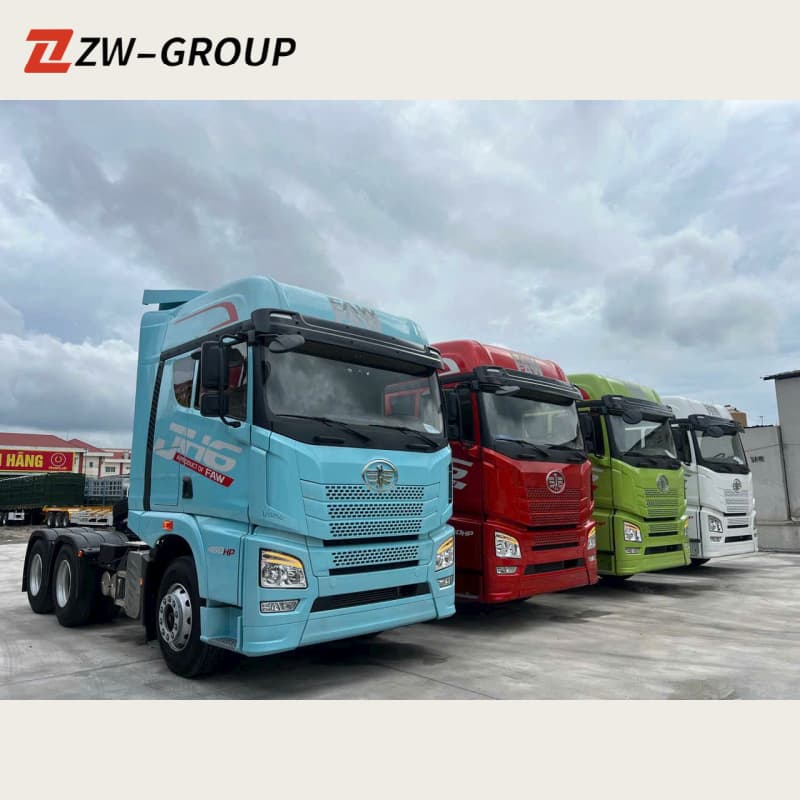 |
FAW Tractor Truck 520HP 6x4 (Multiple Colors)High-performance commercial towing tractor for long-haul logistics and transportation. |
What Defines the FAW Truck's Technical Edge?
At its core, the modern FAW heavy duty truck is a product of rigorous engineering designed to withstand extreme weight and punishing road conditions. The flagship models for the DRC market, particularly the FAW J6P series, are built around a philosophy of structural robustness and mechanical simplicity.
Powertrain Configurations
The heart of these trucks is the CA6DM2 engine, a heavy-duty, high-torque powerplant available in ratings from 420 to 550 horsepower. This engine is specifically designed for low-end torque delivery, allowing the truck to pull away from a standstill under full load on steep gradients common in the Katanga region. It is paired with a FAST manual transmission, known for its durability and ease of field repair. Unlike fully automated transmissions, the FAST gearbox allows for simpler troubleshooting by local mechanics in remote mining camps.
Structural Build and Chassis Design
To handle the extreme payload capacities required in the DRC, FAW utilizes reinforced high-tensile steel frames. The 6x4 tipper and 8x4 dump truck configurations feature heavy-duty multi-leaf suspension systems and double-acting telescopic hydraulic cylinders for the tipping mechanism. This ensures stability when dumping on uneven ground, a critical safety feature in open-pit mines. The chassis is further reinforced with cross-members designed to resist torsional twisting when navigating rutted haul roads.
Where These Trucks Operate: The Environmental Reality
The operational environment in the DRC is a defining factor in equipment selection. It is not merely about moving cargo from point A to point B; it is about surviving the annual cycle of the rainy season, where unpaved roads turn into deep, impassable mud baths.
- The Rainy Season Challenge: Between October and May, heavy rains transform laterite roads into quagmires. FAW 6x4 tipper and tractor units feature a high ground clearance (typically around 300mm) and optimized approach/departure angles to prevent the front bumper and rear overhang from digging into the mud. The aggressive tread patterns on the standard fitment tires provide crucial traction in these conditions.
- Mining Pit Conditions: In the Kolwezi mining sector, the atmosphere is thick with fine, abrasive dust. The FAW's air intake system includes a dual-stage filtration process, with an initial cyclone separator to remove large particles and a secondary paper filter for fine dust. This is a critical design feature that prevents premature engine wear—a common failure point for less robust equipment.
- Long-Haul Routes (N1 and Beyond): For logistics hubs in Lubumbashi, the route south to Zambia and the ports involves long, monotonous stretches interspersed with steep climbs. The truck's cooling system is engineered to handle the high ambient temperatures (often exceeding 35°C) while maintaining consistent engine temperature under full load, preventing overheating on long ascents.
Why Choose FAW Over European Used Trucks?
The choice between a new FAW truck and a used European model is a critical decision point for DRC fleet operators. The answer lies not in brand perception but in the economics of operation in a harsh climate.
Total Cost of Ownership and ROI
While the initial purchase price of a FAW truck is significantly lower than its European counterparts, the total cost of ownership (TCO) analysis reveals even greater savings. New FAW trucks offer a comprehensive warranty and immediate availability of service parts through established networks in Lubumbashi and Kinshasa. European used trucks, while often offering a premium driving experience when new, suffer from rapid component fatigue in the DRC's dusty environment, leading to higher unplanned downtime and expensive part imports.
Fuel Efficiency Under Heavy Load
Fuel economy is a primary concern for logistics firms, with fuel representing up to 40% of operational costs. The CA6DM2 engine's high-pressure common-rail fuel injection system is optimized for fuel atomization, delivering superior efficiency even when running on the lower-grade diesel common in remote mining regions. This translates directly to a higher return on investment (ROI) per kilometer driven, a vital metric for cross-border hauliers.
Mechanical Simplicity and Field Repairs
One of the most overlooked advantages is the mechanical simplicity of the FAW powertrain. The absence of overly complex electronic control modules, coupled with the availability of FAW spare parts Africa wide, means that most major repairs can be performed in the field by a competent mechanic with basic tools. This reduces the need to tow a broken-down truck hundreds of kilometers to the nearest dealership, a significant operational advantage in the remote areas of Lualaba province.
How: Working Principles, Maintenance, and Procurement Flow
Understanding how to operate and maintain these trucks in the DRC's extreme environment is crucial. The procurement process itself is also a specialized logistical exercise that requires careful planning.
Working Principles Under High Stress
Under high-stress conditions, such as hauling a 35-tonne load of copper ore up a 12% grade, the FAW's engine management system automatically adjusts the turbocharger boost pressure to maintain torque output. The cooling system, featuring a high-capacity radiator and a viscous fan clutch, engages full speed to dissipate heat. For the tractor unit, the exhaust brake and FAST transmission's built-in retarder provide controlled descent on downhill gradients, minimizing brake fade—a common cause of accidents on the N1 corridor.
Maintenance Protocols for Dusty Environments
In the highly dusty mining environment, the air filtration system is the single most important component for engine longevity. Operators are advised to check the primary cyclone dust pan daily and to replace the secondary paper filter every 1,000 hours or sooner if the restriction indicator shows high vacuum. Regular greasing of the suspension bushings and U-joints using a high-molybdenum grease is essential to prevent wear from abrasive dust ingress.
Procurement and Shipping to the DRC
The logistics of importing heavy machinery into the DRC is a multi-stage process that requires expertise in both international shipping and customs clearance. The most common and cost-effective shipping routes for importing FAW trucks into the DRC involve one of three major East and Southern African ports:
- Dar es Salaam (Tanzania): This is the preferred port for shipments destined for the eastern DRC and the Katanga mining region. The route from Dar es Salaam to Lubumbashi is well-established, with good road infrastructure for heavy haulage.
- Durban (South Africa): A viable option for trucks destined for the southern DRC, with a well-established logistics corridor via Zambia.
- Mombasa (Kenya): While generally more expensive, this route can be used for shipments bound for the northern and central DRC, including Kinshasa.
The procurement flow involves selecting the appropriate configuration, confirming availability, arranging for Roll-on/Roll-off (RoRo) or containerized shipping, and managing the customs clearance process at the port of entry. Once cleared, inland transport to the final delivery point in Lubumbashi or Kolwezi is coordinated with specialized heavy haulage transport companies.
Technical Specification Comparison: FAW Models for DRC Operations
The following table provides a detailed comparison of the three most common FAW configurations for the DRC market, helping fleet managers select the right tool for their specific operational needs.
| Feature | FAW 6x4 Tipper | FAW 8x4 Dump Truck | FAW 6x4 Tractor Unit |
|---|---|---|---|
| Primary Use Case | Mining pit haulage (ore & overburden) | Construction & aggregate transport | Cross-border logistics & long-haul |
| Engine Model | CA6DM2-42E5 (420 hp) | CA6DM2-46E5 (460 hp) | CA6DM2-50E5 (500 hp) |
| Transmission | FAST 12-speed manual | FAST 12-speed manual | FAST 12-speed with overdrive |
| Payload Capacity | ~25–28 tonnes | ~30–35 tonnes | ~40–45 tonnes (GCW) |
| Suspension | Multi-leaf, heavy-duty | Multi-leaf, heavy-duty | Air / multi-leaf (optional) |
| Typical Body / Application | Steel tipper body (mining spec) | High-volume dump body | 5th wheel coupling (semi-trailer) |
| Ideal Terrain | Deep mining pits, steep ramps | Urban construction, unpaved roads | Highway, N1 corridor, gravel |
| Fuel Tank Capacity | 300L | 400L | 500L + optional 400L auxiliary |
Frequently Asked Questions About FAW Trucks in the DRC
How does the FAW engine handle low-quality diesel common in remote mining regions?
The CA6DM2 engine is engineered with a high-efficiency fuel filtration system that includes a water separator and a primary fuel filter with a 10-micron filtration rating. This system is designed to handle diesel with higher particulate content and water contamination often found in remote fuel depots. Additionally, the high-pressure common-rail system is programmed with a self-diagnostic function that adjusts injection timing to compensate for lower cetane numbers, preventing engine knocking and ensuring reliable starting in cold or damp conditions. For operators in the Kolwezi sector, it is recommended to replace the fuel filter every 500 hours of operation to maintain optimal performance.
What is the availability of genuine FAW spare parts in Lubumbashi and Kinshasa?
FAW has established a robust aftermarket support network across the DRC. In Lubumbashi, there are multiple authorized dealers and parts distributors who maintain extensive inventories of genuine FAW spare parts, including engine components, transmission parts, brake pads, and filter kits. Kinshasa also has a growing network of parts suppliers, with quick access to parts shipped from the port of Matadi. For the most critical mining operations in Lualaba, many fleet operators maintain strategic stockpiles of high-wear items such as brake shoes, clutch plates, and air filters to minimize downtime. The availability of FAW spare parts Africa wide has significantly improved over the past five years, ensuring that logistics hubs in Lubumbashi and Kinshasa are well-supplied.
What shipping routes are most cost-effective for importing FAW trucks into the DRC?
The cost-effectiveness of shipping routes depends primarily on the final delivery point in the DRC. For the mining hub of Kolwezi and the logistics center of Lubumbashi, the port of Dar es Salaam in Tanzania is generally the most cost-effective and time-efficient option. The route offers a clear, established corridor for heavy truck transport, with a journey time of approximately 7-10 days overland. The port of Durban in South Africa is a viable alternative, though it often incurs higher inland transport costs due to the longer distance and the need to cross the Zambian border. For trucks destined for Kinshasa, the port of Mombasa (Kenya) or Dar es Salaam are the primary options, though the inland route from Dar es Salaam to Kinshasa is longer and more complex. It is always advisable to work with a logistics partner experienced in DRC customs procedures to navigate the specific regulatory requirements at each border crossing.