Navigating heavy cargo logistics in Cameroon—from the busy port terminals of Douala to interior infrastructure, timber, and mining projects—requires highly adaptable transport equipment. An extendable lowbed trailer delivers the structural strength and adjustable deck dimensions needed to move massive, over-dimensional loads safely across varying road conditions.
What Is an Extendable Lowbed Trailer and How Does It Operate?
An extendable lowbed trailer (also known as a telescopic lowboy trailer) is specialized heavy-haul equipment designed with a length-adjustable main deck. Built around a robust telescopic center beam, the trailer deck can extend from its compact standard length (such as 13.5 meters) up to 17 meters or longer depending on cargo requirements. This dynamic adjustment allows transport companies to switch easily between standard equipment haulage and extra-long cargo transport using a single trailer chassis.
The extension mechanism utilizes high-strength pneumatic or hydraulic locking pins that secure the inner beam into pre-machined slots along the outer frame. Made from high-tensile steel (such as HG60 or Q690), the main chassis resists bending and torsional flex even when fully extended under high-tonnage loads.
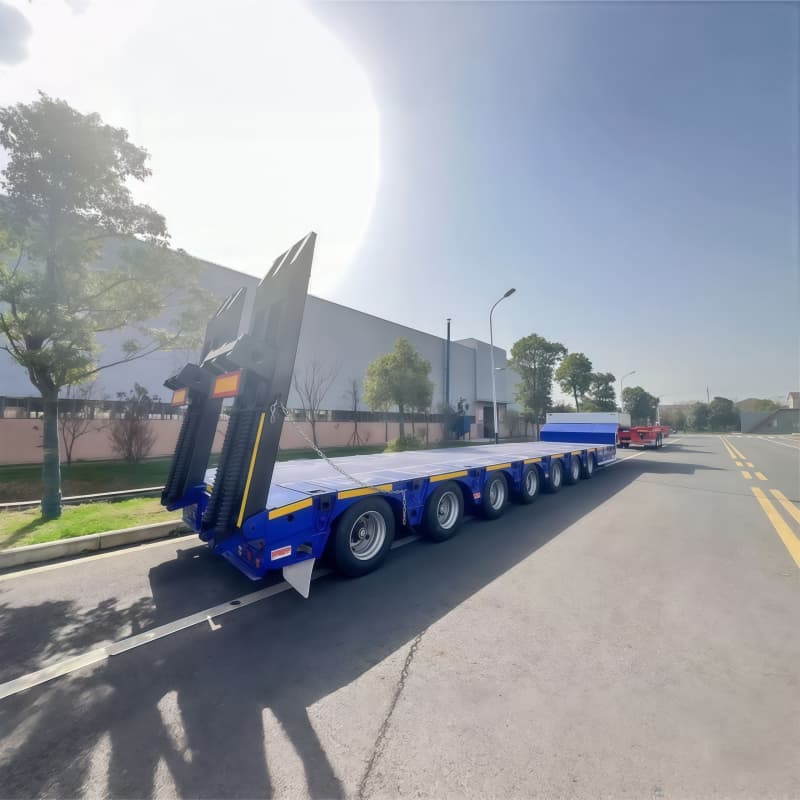 |
Extendable Lowbed Trailer 13.5m-17m 140t 7 Axles Blue
High-capacity extendable lowbed trailer designed for heavy-duty machinery transport. |
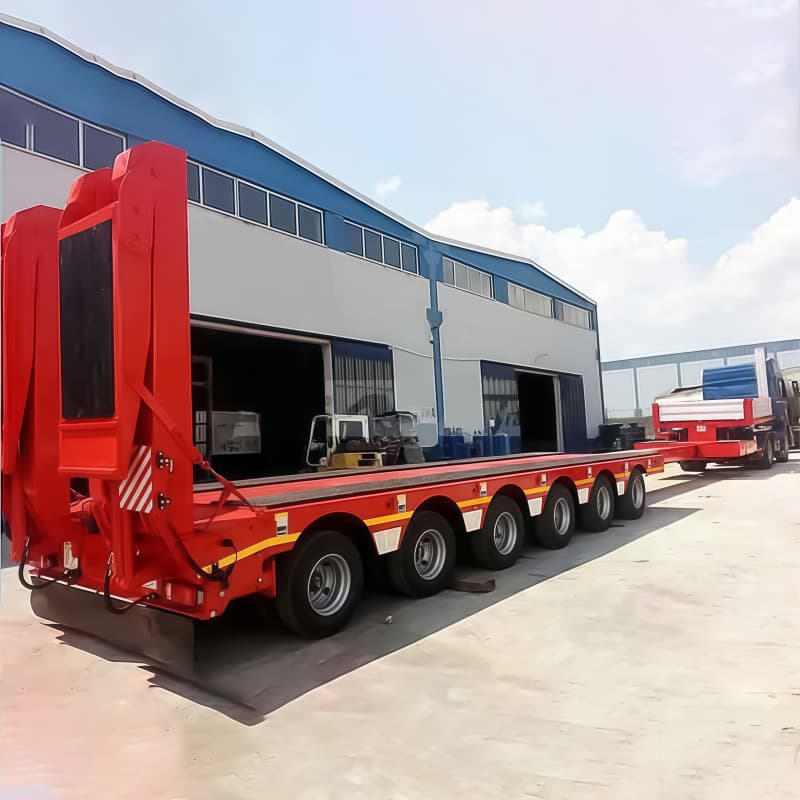 |
Extendable Lowbed Trailer 13m-16m 120t 6 Axles Red
Reliable 6-axle extendable lowbed trailer suitable for oversized equipment loads. |
- Telescopic Main Beam: Easily adjusts to various cargo lengths with heavy-duty locking positions.
- Ultra-Low Deck Height: Maintains a low center of gravity for maximum vehicle stability on challenging transport routes.
- Heavy-Duty Ramp Systems: Reinforced mechanical or hydraulic loading ramps allow easy access for tracked excavators, cranes, and heavy earthmovers.
Who Needs Extendable Lowbed Trailers in Cameroon's Industrial Sector?
Heavy transportation operators, civil engineering contractors, forestry logistics firms, and energy sector companies across key hubs like Douala, Yaoundé, Garoua, and Kribi require versatile freight solutions. As major road, bridge, and energy infrastructure expansion continues, transport teams frequently face changing demand between shifting standard machinery and moving long structural materials.
Where Are Extendable Lowbed Trailers Used in Local Operations?
The diverse terrain and infrastructure demanding environment in Cameroon require rugged, multi-purpose trailer designs:
- Port Logistics & Transit Freight: Moving heavy imported machinery and long structural components from Douala Port and Kribi Deep Seaport inland or to landlocked neighboring regions.
- Mining & Quarry Projects: Relocating long conveyor frameworks, crushing plants, and heavy excavators to remote mining sites.
- Road & Bridge Construction: Transporting long concrete precast beams, steel girders, and bridge piling structures directly to construction sites.
- Energy & Utility Operations: Hauling long pipeline segments, industrial generators, and heavy structural modules for energy infrastructure projects.
Why Choose an Extendable Design Over a Fixed Lowbed?
Investing in telescopic lowboy technology offers significant financial and operational benefits over fixed-frame lowbed trailers:
Fleet Efficiency & Flexibility: Rather than maintaining separate standard lowbeds and dedicated long-load trailers, an extendable lowbed handles both tasks. This versatility optimizes fleet utilization and lowers capital costs.
Weight distribution is another vital factor. Extending the deck distributes weight across a larger surface area and multi-axle combinations (such as 6-axle or 7-axle setups), reducing concentrated axle loads, protecting tires, and helping operators adhere to highway weight regulations.
When Should Operators Extend the Trailer Deck?
The telescopic beam should be extended when cargo length exceeds standard lowbed boundaries and cannot be safely transported with excessive overhang. Operators must evaluate load specifications before departure:
- Retracted Position: Best for standard machinery (e.g., bulldozers, wheel loaders, compact drill rigs) to keep overall vehicle length shorter and maximize maneuvering in narrow roadways and city corridors.
- Extended Position: Used on highway corridors or open transport routes when carrying structural girders, industrial piping, or elongated machinery modules.
How to Choose the Right Trailer Specifications for Heavy Operations?
Selecting the appropriate trailer setup depends on your targeted payload weight, cargo dimensions, and typical travel routes. Multi-axle configurations combined with heavy-duty mechanical leaf spring or air suspension guarantee stability and load support across varied road conditions.
| Specification Feature | Standard Fixed Lowbed | Heavy-Duty Extendable Lowbed |
|---|---|---|
| Deck Length Capability | 13.0m Fixed Length | 13.5m Retracted / 17.0m Extended |
| Payload Capacity Range | 50 - 80 Tons | 120 - 140 Tons |
| Axle Configuration | 3 - 4 Axles | 6 - 7 Axles |
| Main Frame Material | Q345B Steel | HG60 / Q690 High-Tensile Steel |
| Beam Architecture | Standard I-Beam Chassis | Reinforced Box-Section Telescopic Beam |
Essential Pre-Purchase Technical Checklist
Before purchasing an extendable lowbed trailer for tough transport environments, examine these core components:
- Beam Locking Pin System: Ensure pneumatic or manual locking mechanisms operate smoothly and lock securely into place without mechanical play.
- Protected Cable and Hose Carrier: Verify that sliding cable chains or energy tracks shield air brake hoses and electrical lines from pinching or abrasion during extension.
- Axle & Suspension Rating: Match total vehicle weight requirements against high-capacity axles (e.g., 13T to 16T per axle ratings) paired with heavy-duty multi-leaf spring systems.
Frequently Asked Questions
Q1: Why are 6-axle or 7-axle extendable trailers preferred for 100+ ton payloads?
Adding more axles increases the overall load rating and distributes heavy concentrated weight across more tires and contact points. This reduces wear on roads, enhances braking performance, and meets legal transport requirements.
Q2: How do sliding telescopic beams prevent damage from mud and road debris?
High-quality extendable trailers use built-in scraper rings and internal brass or synthetic guide plates that clear away dirt, mud, and grit whenever the telescopic beam is extended or retracted.
Q3: Can the trailer deck be locked at intermediate extended lengths?
Yes, telescopic main beams are manufactured with multiple pre-drilled pin positions along the chassis, allowing operators to lock and operate the deck securely at intermediate lengths suited to their specific load.